Harrer Ingenieure is testing the advantages of ALLPLAN Civil in structural analysis and design on a new precast bridge in the Ahr Valley – and is more than satisfied with the results.
In summary: > Following the 2021 floods in the Ahr Valley, numerous bridges had to be rebuilt, including a new pedestrian and cycle bridge. > Harrer Ingenieure used ALLPLAN Civil to model, analyze, and design the new prestressed precast bridge with in-situ concrete components. > Parametric, axis-based modeling enabled precise representation of geometry, construction stages, tendon layouts, and load combinations. > Integrated structural analysis, automatic load combinations, and Python-based reinforcement generation streamlined verification and documentation. > ALLPLAN Civil simplified the complex bridge reconstruction and improved coordination between design and structural analysis. |
The 2021 floods in Rhineland-Palatinate and North Rhine-Westphalia were among the worst natural disasters in recent German history. 135 people died along the Ahr alone, a left tributary of the Rhine. At the same time, over 9,000 buildings and a considerable part of the infrastructure in the Ahr Valley were destroyed, including more than 100 bridges. The reconstruction, costing billions, is still ongoing today. Harrer Ingenieure is responsible for the structural engineering inspection of the replacement pedestrian and cycle bridge. The engineering firm, with offices in Karlsruhe, Ostfildern, and Baden-Baden, tested the possibilities of integrated structural analysis and design in ALLPLAN Civil.

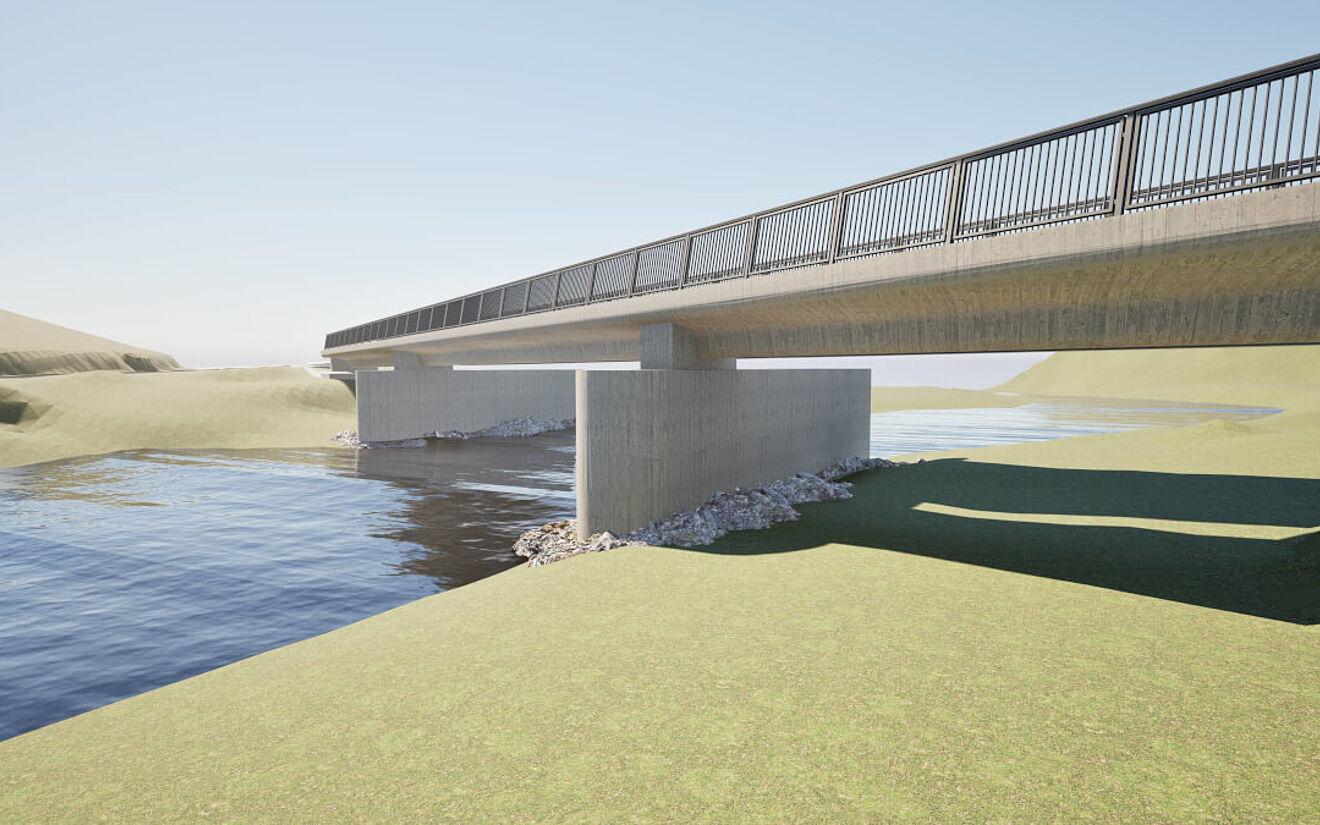
Prestressed prefabricated element with in-situ concrete cross beams and slab
The pedestrian and cycle bridge runs parallel to a railway overpass that is also being newly constructed, with both bridges sharing the same supports and piers. The structure, which runs in a straight line, spans three fields with individual spans of 22, 27, and 18 meters. In terms of construction, it is a single-web plate girder designed as a prestressed precast element with in-situ concrete cross beams and slabs. The entire superstructure is supported on two elastomeric bearings in each axis, using a statically determined bearing arrangement with no restraint. The 250-millimeter-high in-situ concrete slab and the 850-millimeter-thick precast elements result in a constant construction height of 1.10 meters. In order to offer the smallest possible surface area in the event of flooding, the cross-section is designed to be streamlined.
The tendons – three in each of the outer precast elements and four in the middle one – run approximately parabolically across the span length and are thus adapted to the moment distribution. Prestressing is carried out retrospectively, and sheaths are then grouted. There is no prestressing of the superstructure in the transverse direction. In addition, the tendons run exclusively along the span, not over the supports. The precast elements are placed on an auxiliary assembly structure, which means that after the in-situ concrete slab and cross beams have been cast, the static system changes from a single-span beam system to a continuous beam system.
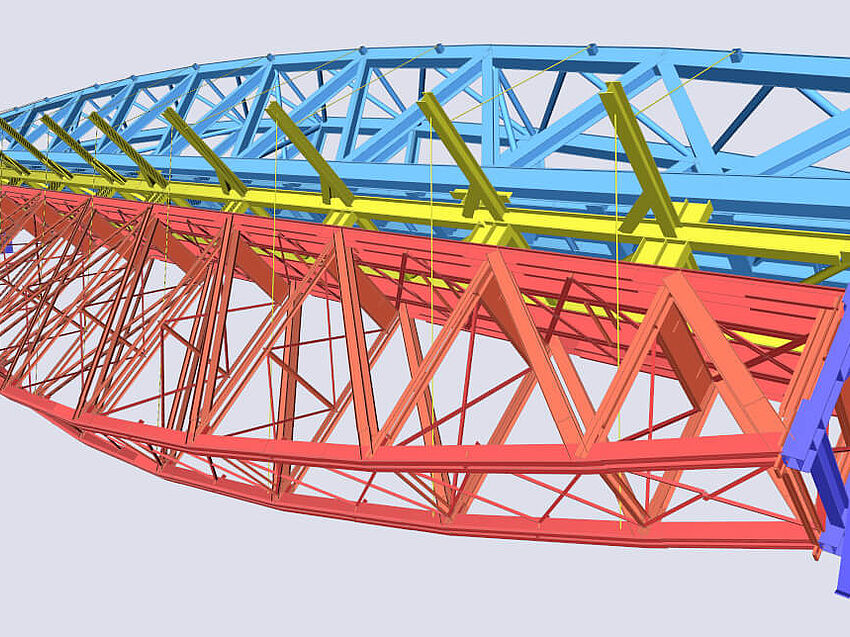
 Copyright: Harrer Ingenieure; 3D geometric model of the superstructure in ALLPLAN Civil
 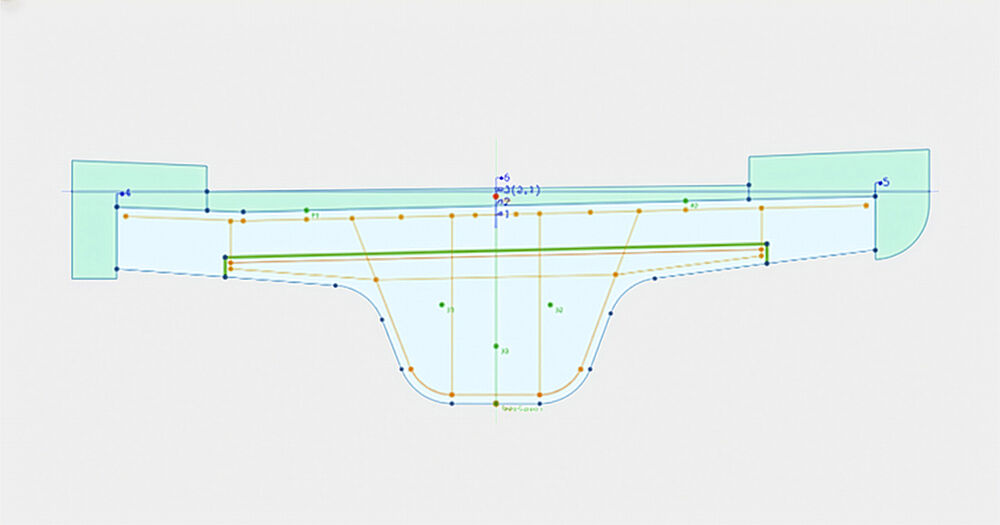 Copyright: Harrer Ingenieure; Cross-section of the superstructure with reinforcement property sets
 Modeling and static design in ALLPLAN Civil
Harrer Ingenieure used ALLPLAN Civil to create the calculation model, including new functions from ALLPLAN 2025 such as Python part reinforcement. The implementation planning by the responsible engineering firm SSF Ingenieure served as the basis for the design. The workflow was as follows.
The axes of the pillars were rotated in the floor plan, resulting in a varying geometry of the beams. For the main cross-section, Harrer engineers defined edge lines and construction joints as well as main reinforcement groups, including corresponding Python parts for automatic reinforcement generation in ALLPLAN Engineering. Parametric modeling allowed for precise mapping of the geometry, thus forming the basis for the most accurate static calculation and design possible. At the same time, temporary and permanent supports could be easily configured. For the tendons, which each have their own geometries due to the changing beam shapes, the material definition was carried out manually according to static requirements. In this way, both prefabricated parts and the composite state could be calculated and different tensioning processes taken into account.
During the construction phases, the relevant loads were recorded, with visualizations facilitating correct placement. Load combinations were then generated automatically and the results, such as internal forces, displacements, and reinforcement details, were clearly presented in diagrams and tables. The final design verification with direct references to standards greatly facilitated the verification process and report generation.
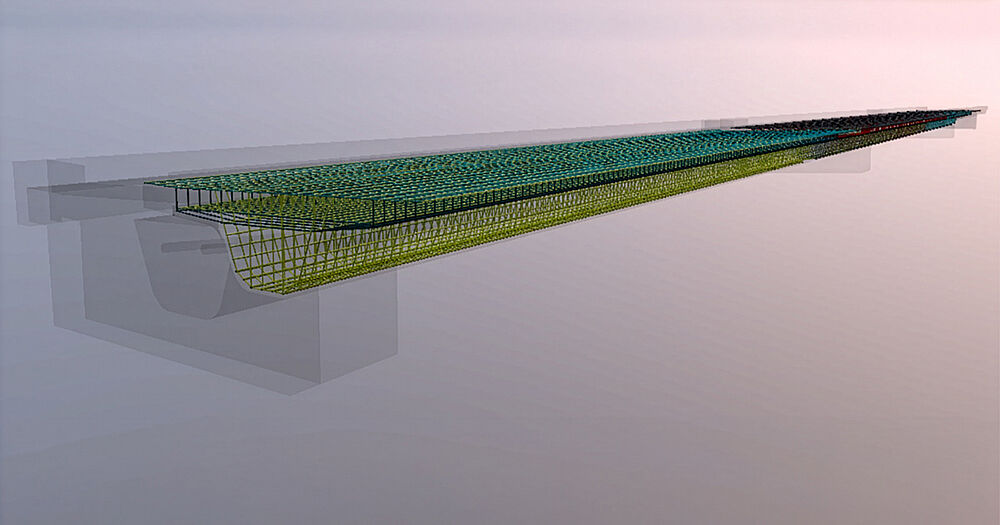 Copyright: Harrer Ingenieure; 3D reinforcement model of the superstructure in ALLPLAN, created using automatic reinforcement
 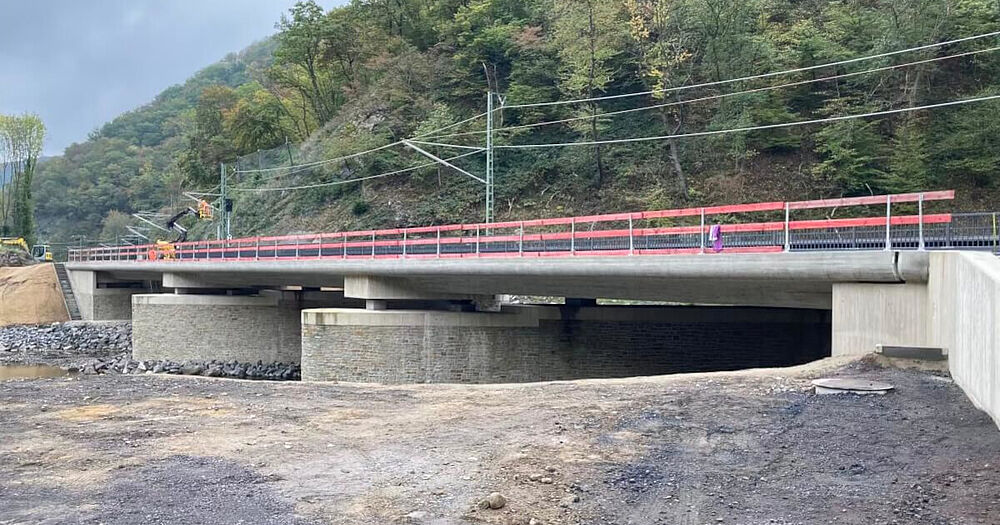 Copyright: Harrer Ingenieure
 Parametric planning simplifies rapid modeling
Harrer Ingenieure had a thoroughly positive experience during its work with ALLPLAN Civil. "The parametric and axis-based planning in ALLPLAN Civil simplifies subsequent changes and rapid modeling," summarizes Vincent Olfers, civil engineer at Harrer. "The integration of the structural design software into the ALLPLAN environment has once again significantly simplified the interface between planning and design."
According to Olfers, the easier collaboration between the various planning phases now makes it easier to take changes and adjustments to the geometry into account throughout the entire work process. At the same time, ALLPLAN Civil also simplifies and improves BIM-compliant planning. Another added value is the special input – for example, of loads – which can be used to create additional construction sequences or construction sequence diagrams.