Wallisellenstrasse: A Road Construction Project Delivered with 100% BIM
BIM Champion 2025 KREBS+KIEFER is drawing on all its planning expertise for the "Reactivation of the Siemensbahn" project – and making intensive use of ALLPLAN in BIM planning.
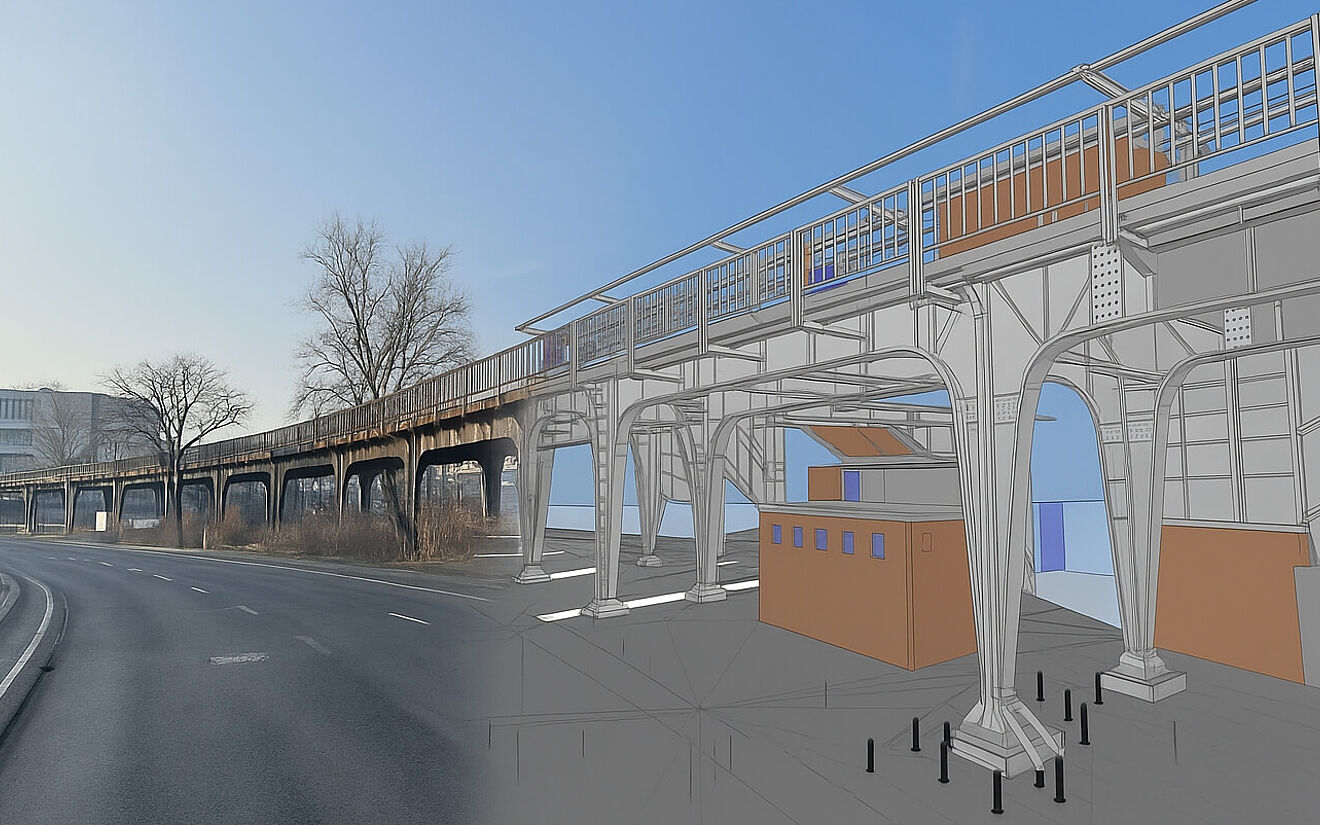
Between 1929 and 1980, the Siemensbahn provided access to Siemensstadt in the east of Spandau, after which it lay dormant – and was not necessarily missed at first. However, this has changed significantly in the meantime. Since 2011, the whole of Berlin has been growing at a rapid pace, including the once rather sleepy district of Spandau. On top of that, Siemens plans to transform the old Siemensstadt into an innovation and residential location – the "Siemensstadt Square" – by 2030. For these reasons, the four-and-a-half-kilometer S-Bahn line between Jungfernheide and Gartenfeld is now to be reactivated by 2029. The Siemensbahn engineering consortium responsible for the groundbreaking planning of the first construction phase was recently named BIM Champion 2025 by buildingSMART. Award winner KREBS+KIEFER provides an insight into the ALLPLAN tools that contributed to this masterpiece.
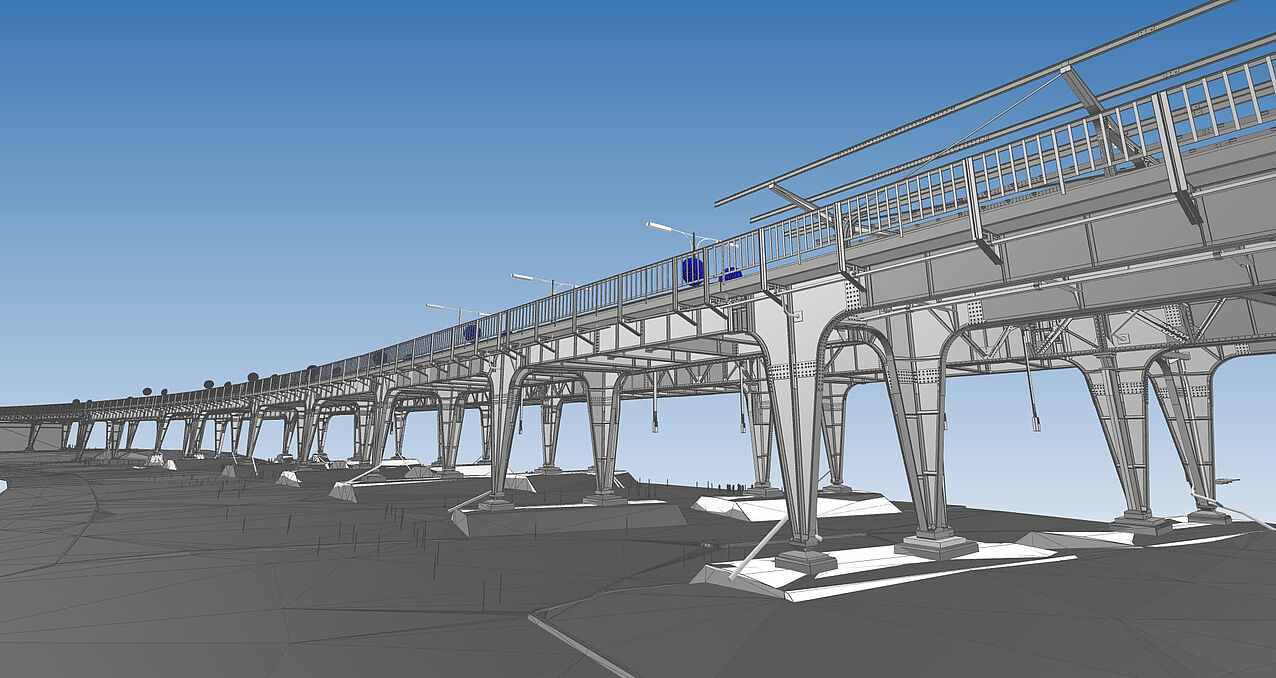
The Siemensbahn engineering consortium consists of the two companies Sweco and KREBS+KIEFER. The two subcontractors ARC-GREENLAB and GI-CONSULT are responsible for surveying services and as-built modeling. KREBS+KIEFER is the technical leader for the overall project and is also entrusted with the sub-project management for structural engineering (KIB). As part of this major construction project, numerous engineering structures must be modernized and repaired. In addition to the complete renewal of the superstructure and technical equipment between the two terminal stations Jungfernheide and Gartenfeld, the repair and upgrading of the 800-meter-long, listed steel viaduct is a central planning task of the first construction phase.
Innovative planning in ALLPLAN
In order to make planning as efficient and precise as possible, KREBS+KIEFER is making use of the extensive possibilities offered by ALLPLAN for parametric planning, among other things. The parametric bridge modeler in ALLPLAN is likely to be used frequently in the course of the project. However, the office has "built" many of the planning tools used to date itself for its individual purposes with the help of visual scripting. These PythonParts impressively demonstrate that resourceful engineers can also create their own extremely powerful solutions with ALLPLAN when needed.
Building structure
An important prerequisite for cross-project collaboration in OPEN BIM via the IFC interface is a building structure with defined structural levels. KREBS+KIEFER therefore uses the building structure function in ALLPLAN to predefine these in ALLPLAN in accordance with project-specific requirements and the client's BIM specifications. This ensures that the structure specified in the BAP (BIM execution plan) is maintained when models are exported as IFC.
PythonPart for automated attribution
It is the attribution that makes a model an intelligent BIM model. KREBS+KIEFER uses self-created PythonParts to automatically assign attributes to the respective components. The information is obtained from Excel tables that have been filled with the required SOM-compliant attribute lists. At the same time, attributes already created in the components can be exported to an Excel table for quality checking, checked, and then "reimported." This creates additional security and a better overview of the project.
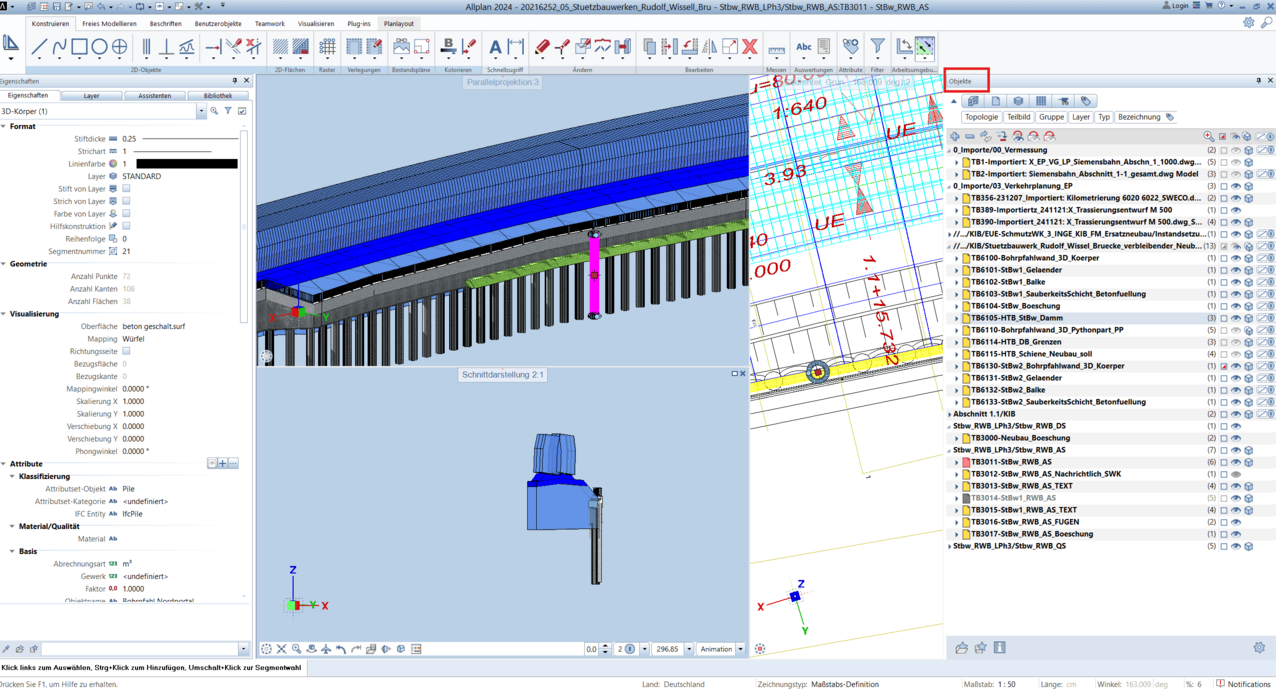
Intelligently filter and assign information via the object palette
Given the enormous density of information in BIM models, intelligent filtering and assignment of information is particularly valuable in large-scale projects such as the reactivation of the Siemensbahn railway. KREBS+KIEFER uses the object palette in ALLPLAN to selectively show and hide project information or arrange it flexibly. This makes the control of project data much smoother, more precise, and more efficient. The object palette offers practical and time-saving solutions, especially for tasks such as changing all texts across multiple drawings or quickly hiding all labels (texts and dimension chains). At the same time, the ability to create favorites is particularly important when working on large projects with multiple ALLPLAN users, as it supports consistent workflows and efficient teamwork.
Railing tool
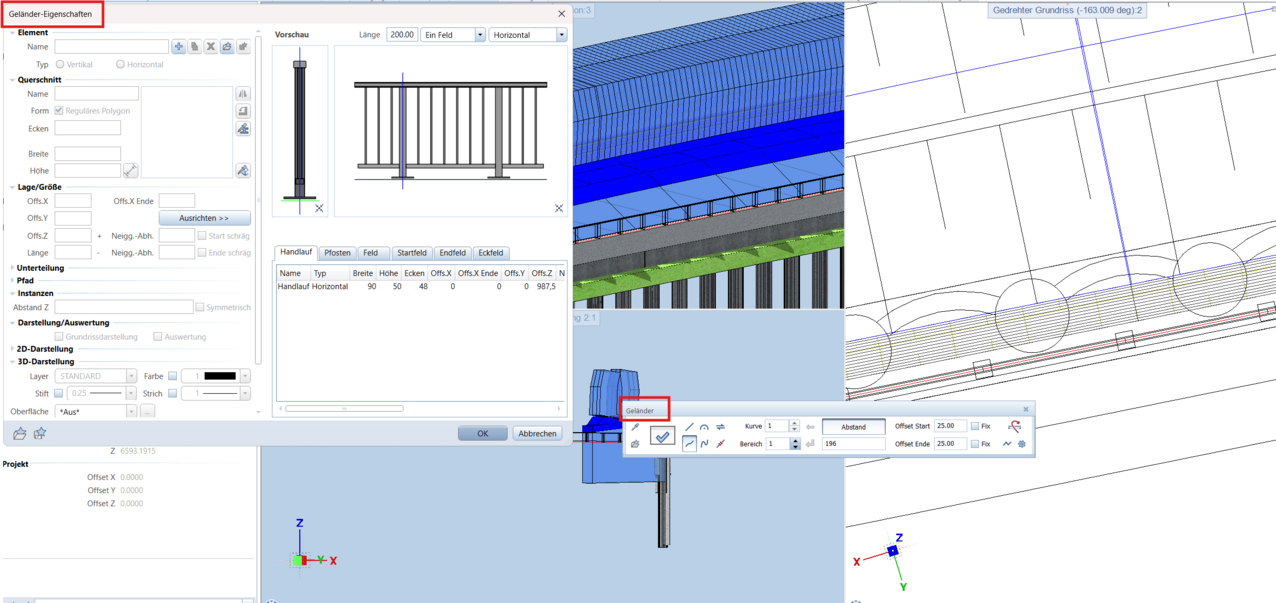
One tool that is indispensable for a project such as the Siemensbahn reactivation is the parametric railing tool in ALLPLAN. This proves particularly useful for railings that have to be created according to specific regulations such as RIL-Gel. All you need to do is configure the railing once with the appropriate parameters and save it as a favorite so that you can reuse it anywhere you need it. At the same time, the railing tool can be used to retroactively customize standardized components from libraries and flexibly define railing axes. This makes it suitable for both standard applications and individual requirements.
Tip: Since almost any profile can be defined as a "handrail" or "post," the railing tool can be used for much more than just railings. This helpful tool can also be used to extrude or copy any profile along a path.
Extended PythonPart "Bored Pile Wall"
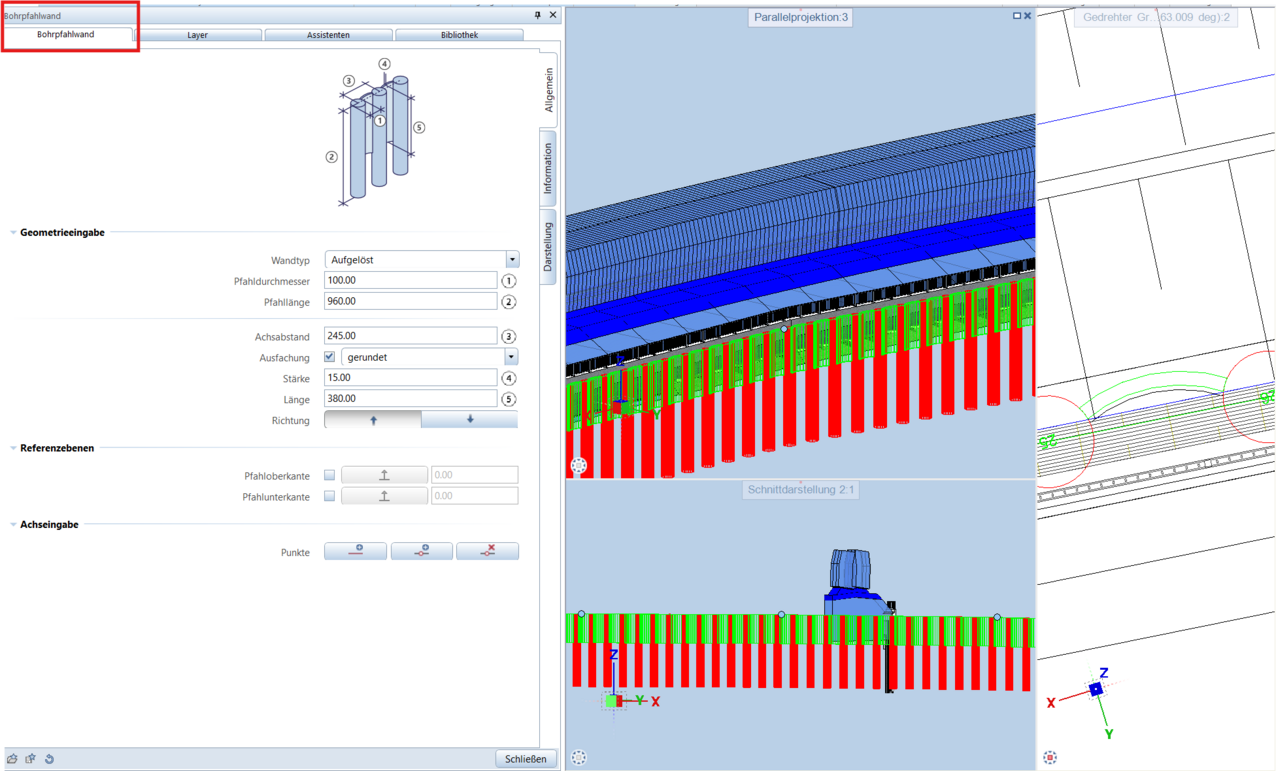
The PythonPart "Bored Pile Wall" in ALLPLAN greatly simplifies the modeling of complex retaining walls of this type. The ability to generate automatic and associative labels and dimensions makes the work process much more efficient. A key advantage is its flexible adaptability. The parameters of the bored pile wall can be changed and customized at any time. This saves a lot of time and effort, as in classic 3D free modeling, every change is equivalent to almost completely remaking the model.
In PythonPart itself, the "Information" tab allows you to select or customize concrete properties, empty holes, and the IFC object type. In addition, the "Display" tab allows you to configure the formats for texts, geometries, and dimension lines. KREBS+KIEFER is using a specially extended version of the standard PythonPart for the reactivation of the Siemensbahn, which has been supplemented with concrete infill.
PythonPart "ÜKO according to DB-RIL"
KREBS+KIEFER has programmed another enormous work simplification specifically for the project using visual scripting in ALLPLAN: a PythonPart that can be used to parametrically model transverse and longitudinal joints. This tool not only saves time and effort in modeling well over 100 individual joints on the steel viaduct, it also ensures high quality and precision in the design. In addition to the standardized ÜKOs according to DB-RIL, the self-created PythonPart also includes the option of flexibly defining deviating parameters. ALLPLAN users can select the ÜKO 3D axis at any time, define it with a mouse click, or adjust it retrospectively—which further speeds up and simplifies the work process.
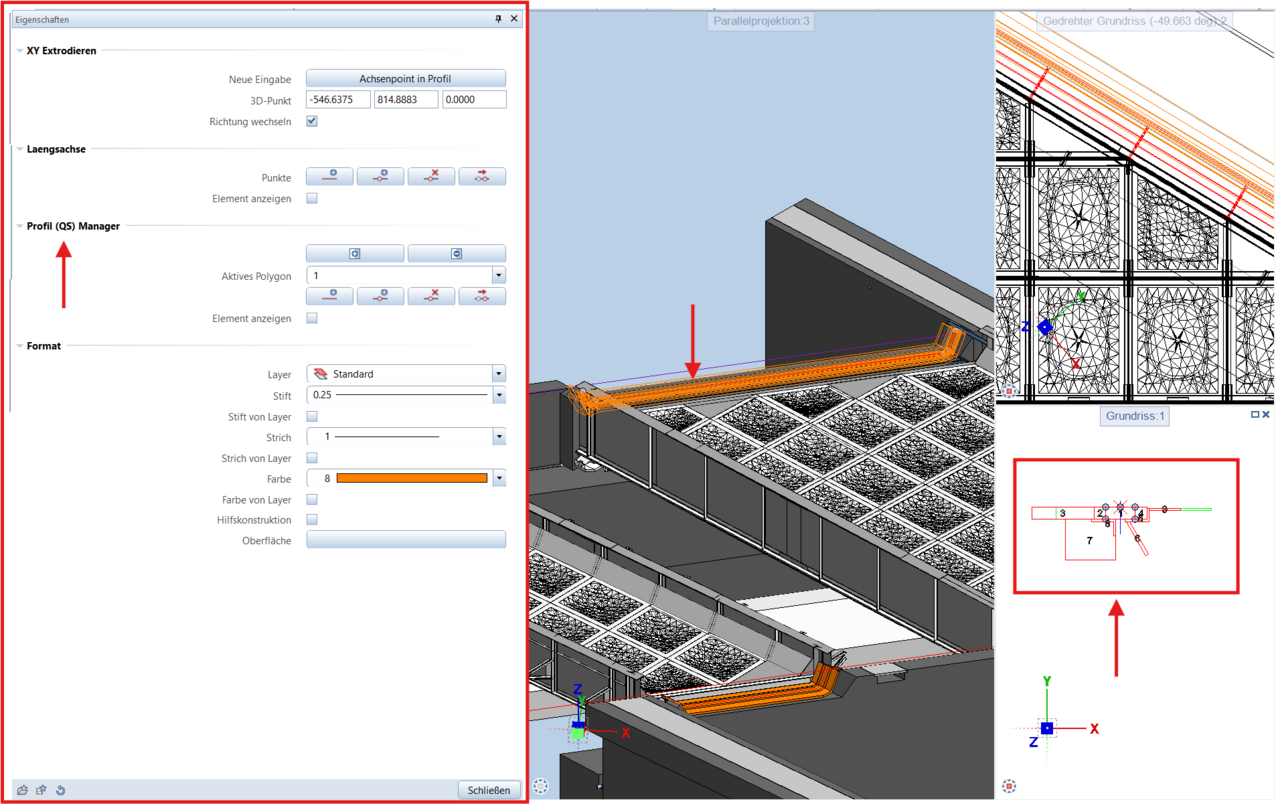
PythonPart "XY Extrude along 3D path"
One of the most helpful functions when modeling infrastructure structures in ALLPLAN is "Extrude along path." However, this requires precise orthogonal positioning of the profile relative to the 3D axis, which is often a challenge in practice. The added value of a cross-section or profile manager is particularly evident in special DB-RIL transition structures, the modeling of embankments for information purposes, or the head beams of a bored pile wall.
KREBS+KIEFER uses these self-created PythonParts in the project to define individual profiles either with a mouse click or by selecting a cross-section (polygon) previously drawn in 2D. In both cases—both for cross-section definition and for determining the 3D axis—parameterization offers the decisive advantage that adjustments can be made flexibly at any time. This results in a consistently efficient, smooth workflow—even for complex or unconventional design tasks.
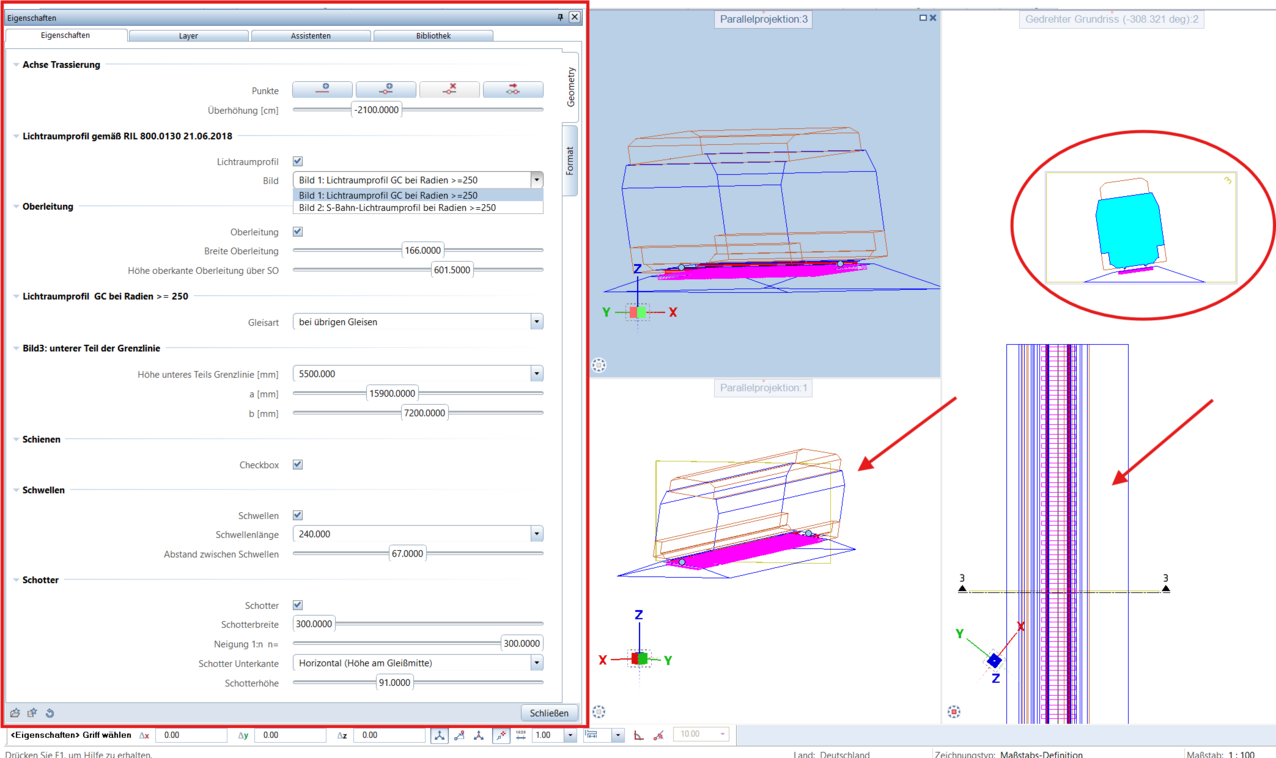
PythonPart "Clearance profile according to RIL
An advanced version of the PythonPart "XY Extrude along 3D Path" mentioned above also determines the profile based on parameters from the DB-RIL for clearance profiles and general alignment parameters. In addition to the two main standard images of the DB-RIL, this tool offers the option of complete customization for special cases based on the parameter values entered. This allows even unusual requirements to be implemented flexibly and precisely.