Author: David Zabka, Detailing and Fabricating Product Manager, ALLPLAN
Steel detailing productivity has always been critical to project success— but the pressure to deliver faster and more accurately is only increasing. In today’s construction environment, schedules are tighter, projects are more complex, and expectations for coordination are higher than ever.
At the heart of this pressure is a simple reality: labor hours are finite. As Modern Steel Construction recently highlighted in its January 2026 issue, labor hours are the ultimate constraint across fabrication and erection, tying every operational decision directly to profitability. When time is limited and demand continues to rise, productivity isn’t just a scheduling concern — it is an economic one.
Detailers feel this acutely. They’re often the last to receive finalized information, yet they’re expected to turn around complete, build-ready deliverables without slowing the project down. At the same time, owners want buildings delivered faster because every day saved gets them to revenue sooner. Add booming demand in sectors like data centers, housing, and healthcare, and it’s easy to see why productivity has become a central topic in steel construction.
But here’s the important nuance: steel detailing productivity isn’t just about working faster. It’s about how effectively time is used across the entire workflow — and how early decisions, clarity, and coordination affect everything that follows. When productivity breaks down, the cost shows up far beyond the detailing desk. That’s where modern tools and workflows make a measurable difference.
Steel detailing productivity refers to how efficiently detailing teams convert labor hours into accurate fabrication and build-ready deliverables — minimizing rework, reducing errors, and enabling downstream fabrication and erection.
Where steel detailing productivity is lost: rework, revisions, and handoffs
If you ask me where steel detailing teams lose the most time, the answer is almost always revisions.
When a design change arrives after work is already done, you’re not just “making an update.” You’re reworking model information, revising drawings, validating impacts, and ensuring those updates don’t create new conflicts. Depending on the scope, that can take hours, days, or even weeks. The bigger the project and the more interconnected the components, the more expensive revisions become.
When labor hours are the ultimate constraint, productivity isn’t about speed alone — it’s about making every hour count by getting it right the first time.
But revisions aren’t the only culprit. Another major time sink is the handoff of incomplete or imprecise information. Engineers are paid to provide a certain level of design detail, and they do their jobs well within that scope. But detailers must take the model to an entirely different level of accuracy for fabrication and constructability.
That gap creates friction. Often, a detailer’s first step is to review what’s been received, widentify missing or unclear information, and send RFIs immediately. It’s not about blaming anyone — it’s about acknowledging that the upstream and downstream teams operate at different levels of detail and have different deliverables.
And in a world where everyone is moving fast, speed can introduce errors. Copy-and-paste reuse, missing details, and rushed decisions can create issues that show up later in the process — exactly where they’re most costly.
Why steel detailing productivity isn’t just about working faster
One misconception I see repeatedly is that productivity simply means doing more work in less time. In reality, moving fast without precision can slow down the entire project.
Here’s why: if something is unclear or incorrect in the detailed deliverables, the fabrication shop has to stop. Shop personnel escalate questions to managers, managers reach out to project teams, and the whole flow slows down. If an issue makes it past the shop and shows up in the field, the cost and delay can be even more dramatic — field cuts, modifications on site, or erection challenges that could have been prevented earlier.
So when we talk about steel detailing productivity, the true goal isn’t “model faster.” It’s deliver correctly and faster — with clarity, consistency, and buildability — so downstream teams can execute without interruption.
What modern steel detailing software should actually deliver
When people hear “steel detailing software,” they often think primarily about 3D modeling. But a detailer’s deliverable is rarely just a model.
Modern steel detailing software improves productivity by supporting the full detailing-to-fabrication workflow, including:
1. Generating accurate shop drawings that clearly define cuts, holes, welds, and assembly requirements.
2. Producing digital drawing packages that support paperless fabrication without sacrificing clarity.
3. Integrating directly with automated shop equipment to reduce manual input.
4. Providing production and tracking data to support scheduling and fabrication workflows.
This is where modern steel detailing software separates itself — not by how fast a user can model, but by how effectively it supports fabrication, production, and delivery downstream.
Automation that still keeps humans in control
Automation is a major contributor to speed and efficiency — but “automation only” isn’t the answer.
What matters is intelligent automation with transparency and control. For example, modern tools can apply rule-based logic to generate connections based on modeling inputs, run through design calculations, and output documentation efficiently. But engineers and detailers still need the ability to review, validate, and adjust outcomes based on real project requirements.
I often describe it as “technology plus human judgment.” We’re all familiar with tools that produce fast results that sometimes don’t fit the real-world situation. Steel detailing is no different. The most effective workflows are the ones where automation accelerates repetitive, time-consuming tasks — but experienced professionals remain in the driver’s seat.
Why ROI is often underestimated
When organizations evaluate steel detailing software, ROI is frequently underestimated because the value doesn’t show up in only one place.
Yes — labor hours saved matter. But the ROI also comes from:
• Keeping automated shop equipment productive (especially as equipment investments grow).
• Reducing drawing cleanup time after modeling.
• Improving the accuracy and clarity of fabrication deliverables.
• Minimizing downstream stoppages caused by missing information.
• Enabling faster response to changes without full rework.
Fabricators, in particular, have strong incentives to adopt workflows that keep production moving. When a shop invests heavily in automation and advanced equipment, it needs a steady, reliable flow of correct data. If they can’t get that, they’ll look for partners and processes that can.
Usability, training, and time-to-value matter
Even the best software won’t improve steel detailing productivity if teams can’t adopt it efficiently. Workflow clarity, usability, and training support play a huge role in whether a new platform actually delivers ROI.
In my experience, when teams change tools, the first project can feel slower simply because they’re learning. But once users understand the workflow and start taking advantage of automation, they see noticeable gains quickly — often reaching parity by the first job, then accelerating on subsequent projects as confidence and proficiency grow.
The key is that modernization isn’t just about changing software. It’s about being willing to learn new workflows that better fit today’s reality.
To explore how teams are improving steel detailing productivity in real-world projects, download our e-book.
My advice for steel detailers and fabricators focused on productivity
If I could give detailing leaders one piece of advice, it would be this: stay educated and keep an open mind.
Technology is evolving quickly — especially in automation and fabrication. The processes that worked five or ten years ago may not be the most efficient today. The teams that win are the ones willing to adopt smarter workflows, embrace new tools, and use technology to their advantage rather than trying to force modern systems into old processes.
Steel detailing productivity isn’t about doing the same things faster. It’s about doing the right things more reliably and faster — with fewer downstream problems and less rework.
Ready to learn more about steel detailing software?
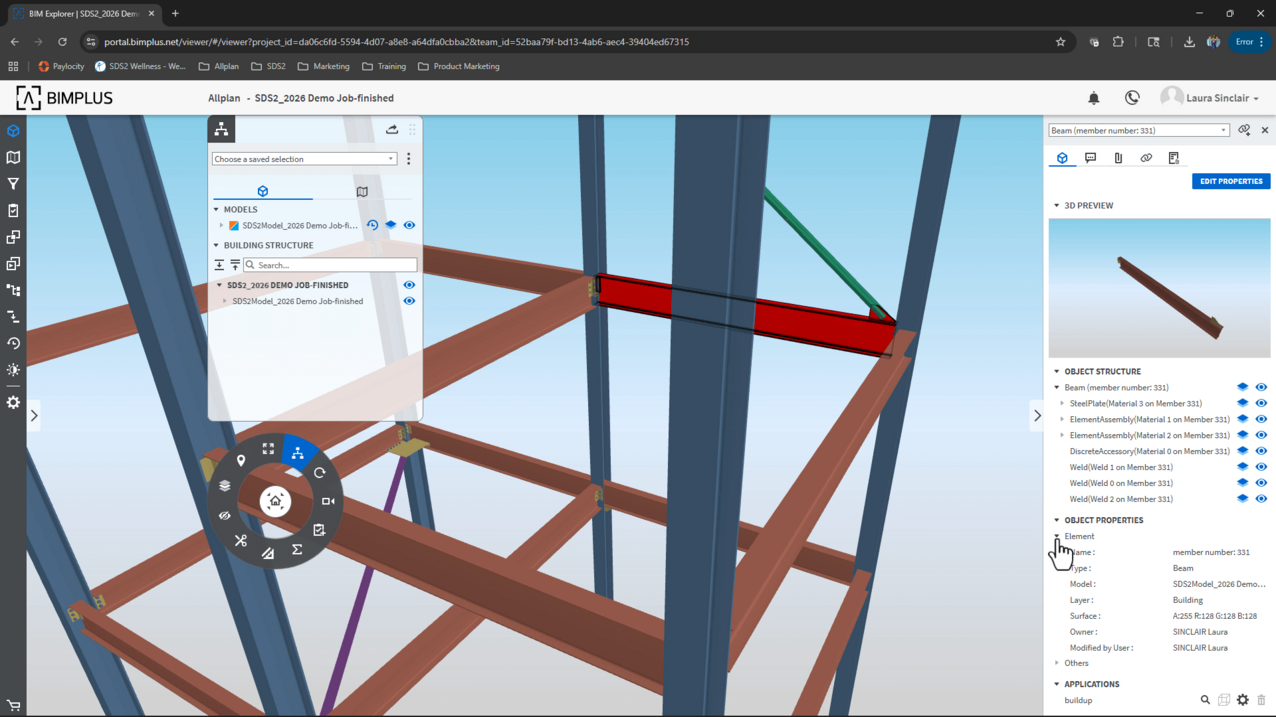
Watch this 10-minute video overview to see how SDS2 by ALLPLAN supports steel detailing and fabrication workflows — from modeling through production.

About the Author
David Zabka has worked in the steel detailing software industry for nearly two decades. He began his career in technical support and customer enablement, later expanding into training, onboarding, pre-sales consulting, and leadership roles. Today, David focuses on product strategy and modernization initiatives spanning detailing, prefabrication, and production workflows — helping teams improve efficiency from model to shop to site.