There is a question that every engineer working on existing railway infrastructure knows well. When you start a new project – whether it’s a bridge rehabilitation, a station upgrade, or a tunnel assessment – before anything else, you look for the technical record (as-built) of the structure.
In summary: > ISPCF’s first BIM pilot addresses the challenge of incomplete technical records for existing railway infrastructure. > At Grădinari Station, eight disciplines were coordinated through a multidisciplinary Open BIM workflow using ALLPLAN Civil, ALLPLAN, Bimplus, and other specialist solutions. > The pilot showed how existing railway inspection standards could be digitized, connecting defects, photographs, actions, and condition information directly to infrastructure assets. > Creating a persistent digital history could give future engineers better information for maintenance, rehabilitation, and investment decisions. > ISPCF’s experience also demonstrates why successful BIM adoption depends as much on people, training, and clear workflows as it does on technology. |
Most of the time, what you find – if you find anything – are the design drawings. What's rarely there is the as-built record: the actual materials used, the quality certificates, what the site engineer observed during construction. Not how the structure was meant to be built. How it was actually built.
More often than not, the technial record is incomplete. Sometimes it's missing entirely. Without it, you don't rehabilitate what you know. You rehabilitate what you assume.
This is not a story about poor record-keeping. It's one about what happens when an entire sector operates for decades without a structured information layer – and what it takes to start building one.
Romania's railway: a paradox in numbers
Romania was among the first countries in Europe to build a railway network. The first line opened in 1854 and by 1880 the country had established one of Europe's earliest state-owned railway administrations. At its peak, the network was the fourth largest in Europe by total track length.
Today, the average commercial speed of passenger trains is 44 km/h, lower than it was in the 1980s. For freight, the national average sits at around 16 km/h.
The infrastructure is there. The EU and national investments are there – over €8 billion was allocated for railway modernization in the 2021–2027 period alone, with Romania sitting at the intersection of two TEN-T Core Corridors connecting Central Europe to the Black Sea.

What's harder to see is the information gap underneath. Without reliable, structured data on the condition of existing structures, modernization decisions are difficult to prioritize. You invest where you can, not always where you should.
As Marius Hazaparu, bridge engineer at ISPCF, explains: the problem isn't only about investment levels. It's about having reliable data that tells you how to prioritize those investments and where to allocate the funding.
The company that designed it – and what they decided to do
ISPCF – Institutul de Studii și Proiectări Căi Ferate (Railway Studies and Design Institute) – has been designing railway infrastructure in Romania since 1947. Many of Romania’s major railway projects of the last century were designed by ISPCF. Today, a team of 140 specialists covers every engineering discipline in the sector.
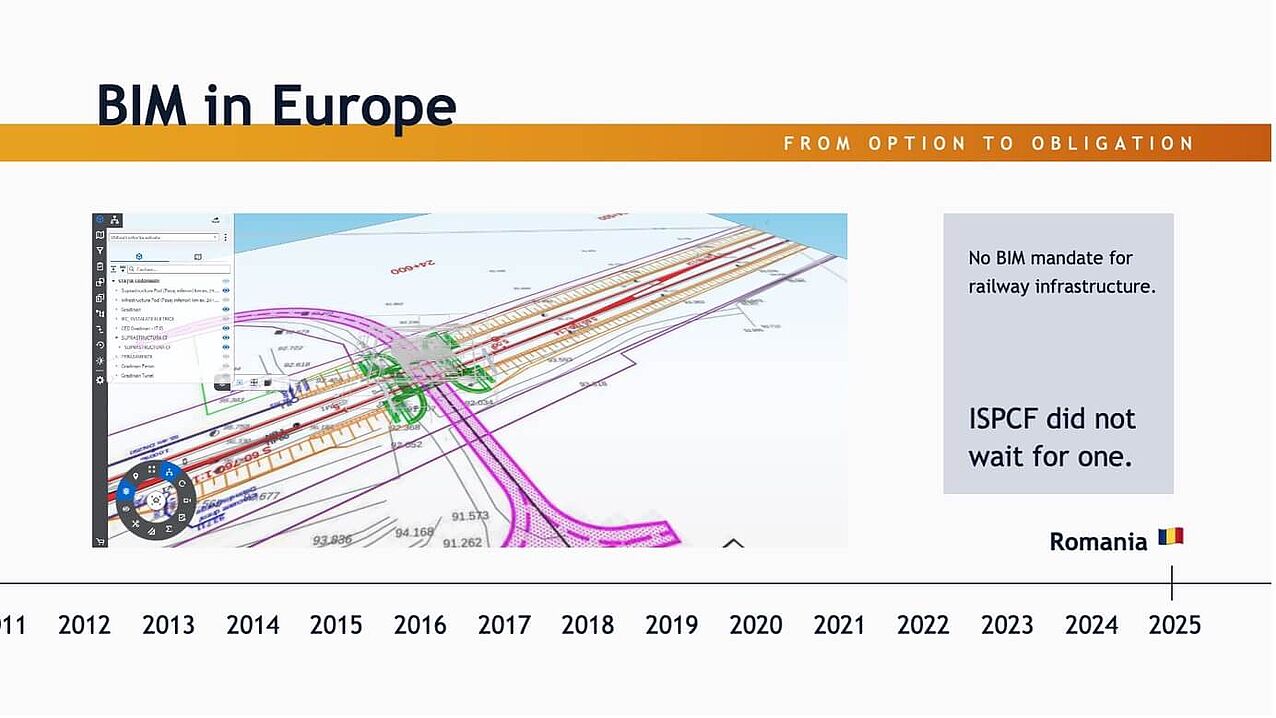
In 2025, ISPCF undertook their first BIM pilot project – not because a mandate required it, but because the people working on Romania's railway infrastructure every day understood what was missing.
There is no law or government regulation in Romania requiring BIM on public infrastructure projects. But BIM-related requirements were beginning to appear in tender documents, even if loosely worded. Public clients were starting to ask for 3D models. And internally, the team felt the friction: data exchange between disciplines could be far more fluid, and when changes were requested, there was no clear, traceable record of what had been asked for and when. So they decided to run a pilot and find out what benefits BIM could offer.
The pilot: Grădinari station
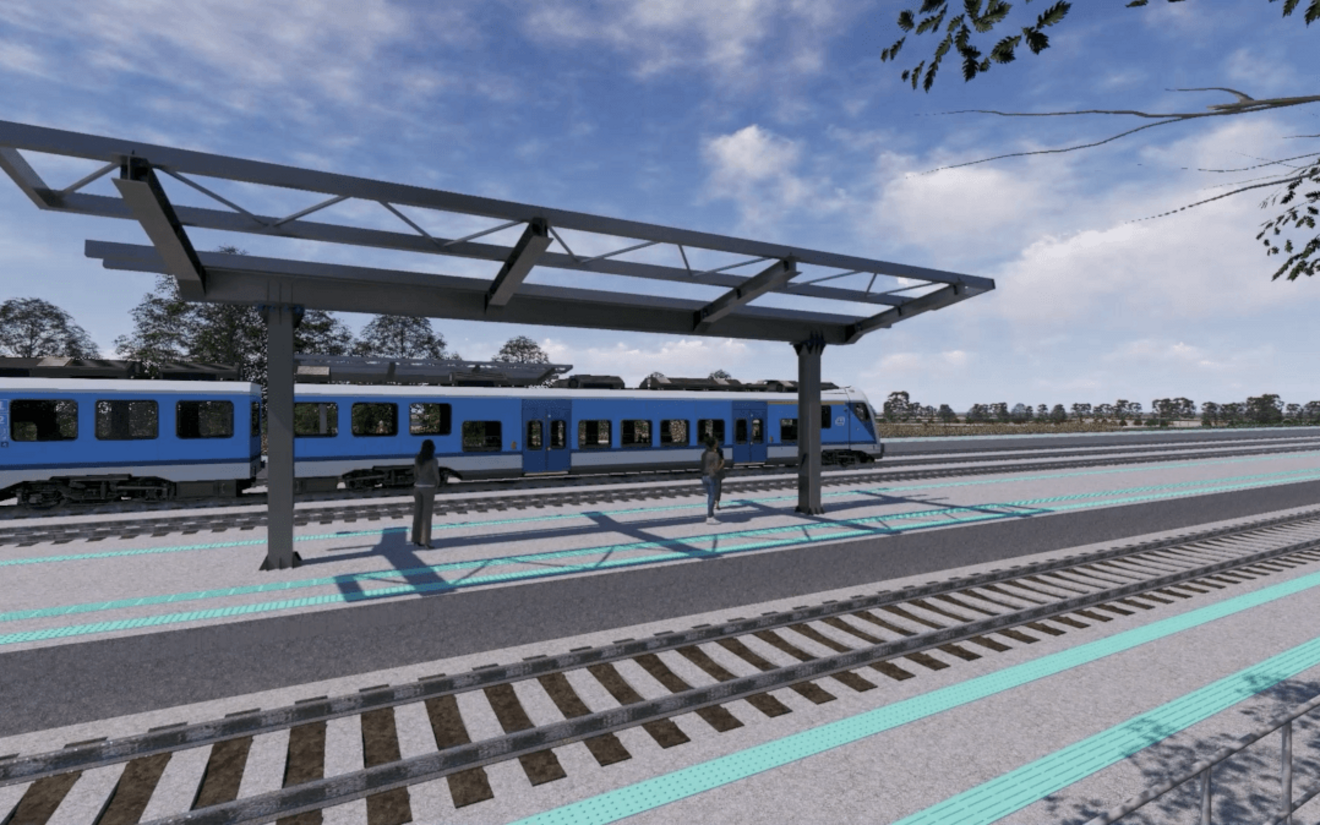
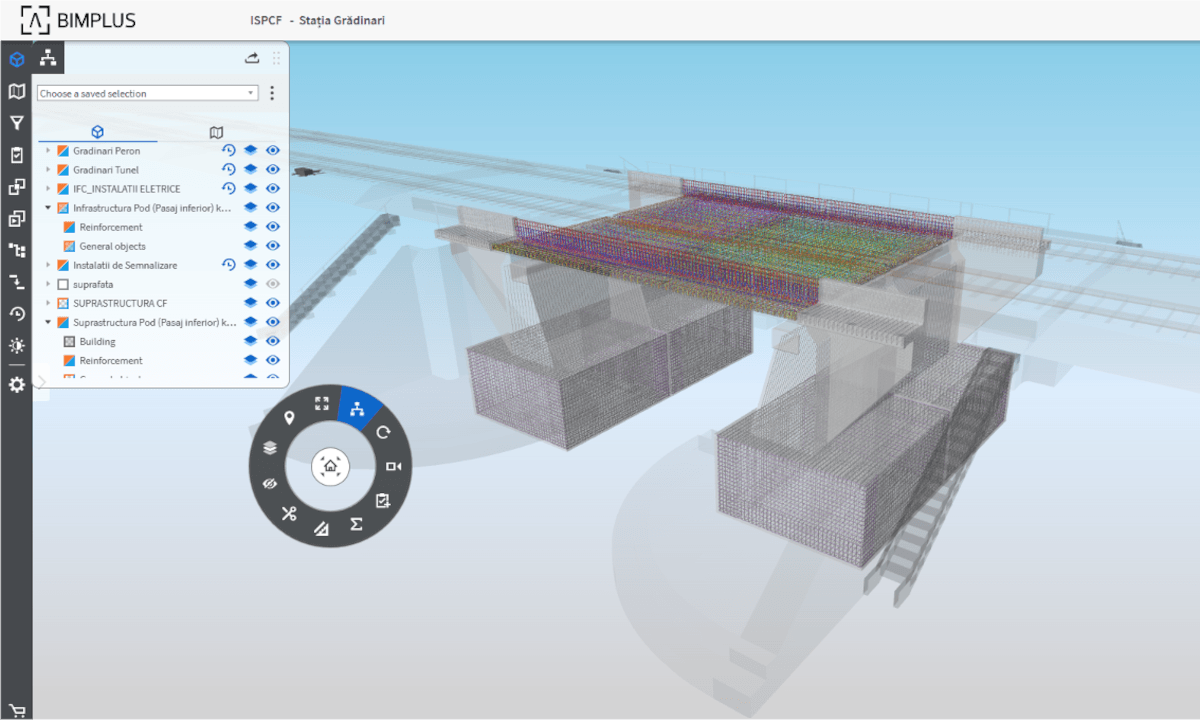
The pilot focused on Grădinari Station, part of a larger design contract ISPCF delivered for CFR (Romanian Railways) on the Bucharest–Craiova corridor. The project included approximately 200 km of railway line, covering both technical design and execution details.
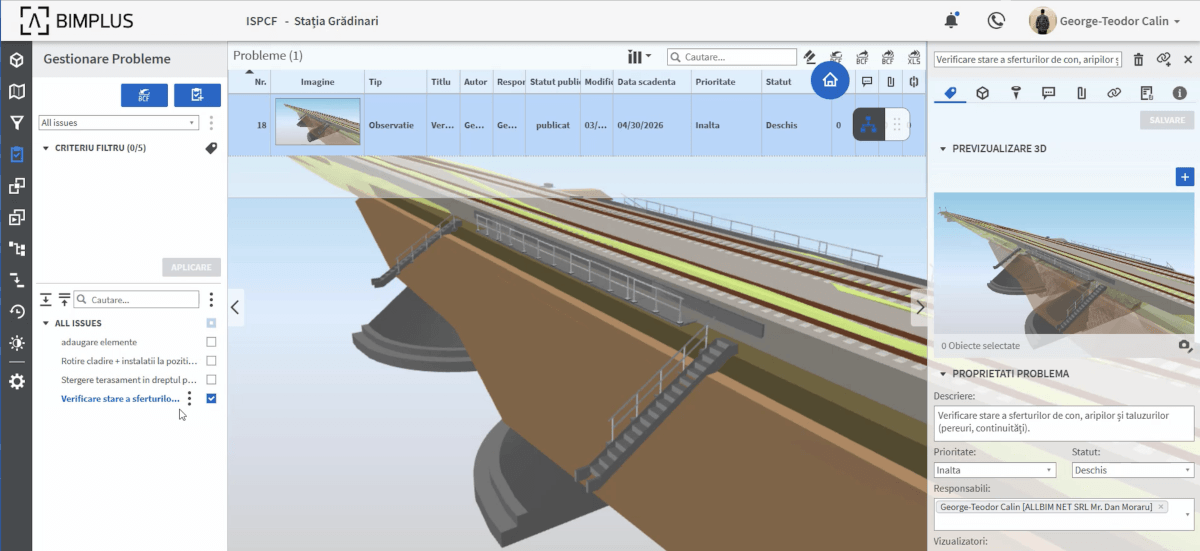
Grădinari was chosen not because it was simple, but because it wasn't. Station architecture, structural engineering, railway superstructure, earthworks, consolidation works, bridge and art structures, railway signalling, telecommunications, a pedestrian underpass, a steel canopy, and roads were all included. That’s eight disciplines, integrated into a single federated model.
If a coherent digital workflow could be built here, it could be built anywhere.
The tools
The bridge was modeled parametrically in ALLPLAN Civil, then detailed and reinforced in ALLPLAN. Railway superstructure and earthworks were handled in PROVI, a specialist application for that area, while the steel canopy was modeled in Tekla and the terrain modeling in Civil 3D. The remaining elements were modeled in ALLPLAN.
BIMPLUS served as the Common Data Environment (CDE). And because all these tools supported open data exchange through IFC 4.3, coordination between disciplines was workable in practice, not just in principle.
The 2D drawings were also overlaid on the 3D models for verification – a deliberate choice for a team in transition. You don't throw everything out. Instead, you build a bridge to the new way of working.
The partnership
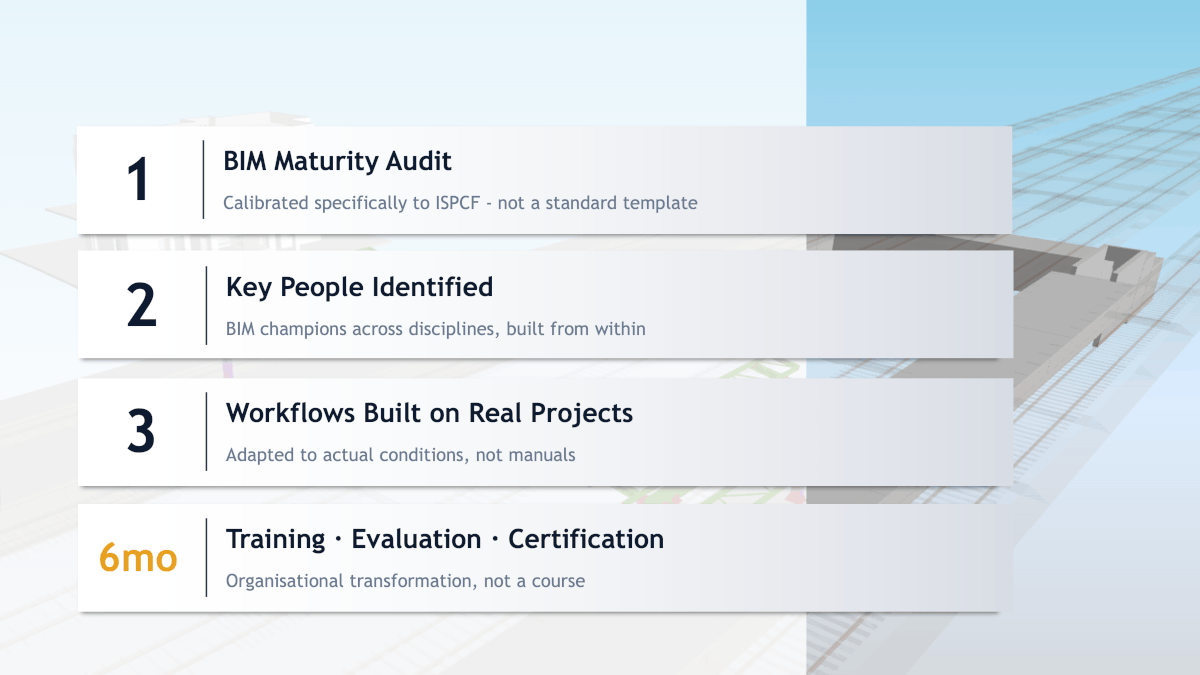
The implementation was developed in partnership with ALLBIM.NET. What ISPCF chose was not an off-the-shelf software package. The process began with a digital maturity audit, for an honest assessment of where the company actually stood. From there, key people were identified across disciplines, teams were built around them, and the training was calibrated to ISPCF's specific context: a foundational phase to understand the processes, followed by applied training directly on the live project.
Six months of training, evaluation, and certification
As Hazaparu observed: the software performed extremely well. The challenge, as always, sits with the people. Once you establish clear workflows and everyone knows their role, the software doesn't stand in your way.
Beyond coordination: a question about the life of a structure
What emerged from the pilot went further than 3D modeling and clash detection, the expected benefits of any BIM implementation.
The team found themselves asking a different question: what happens to the data after a structure is delivered? Who inspects it and how, and where does that information go? The answer, for much of Romania's railway infrastructure, is a physical copy filed at a regional directorate. That’s useful to the person who wrote it, but largely inaccessible to everyone else.
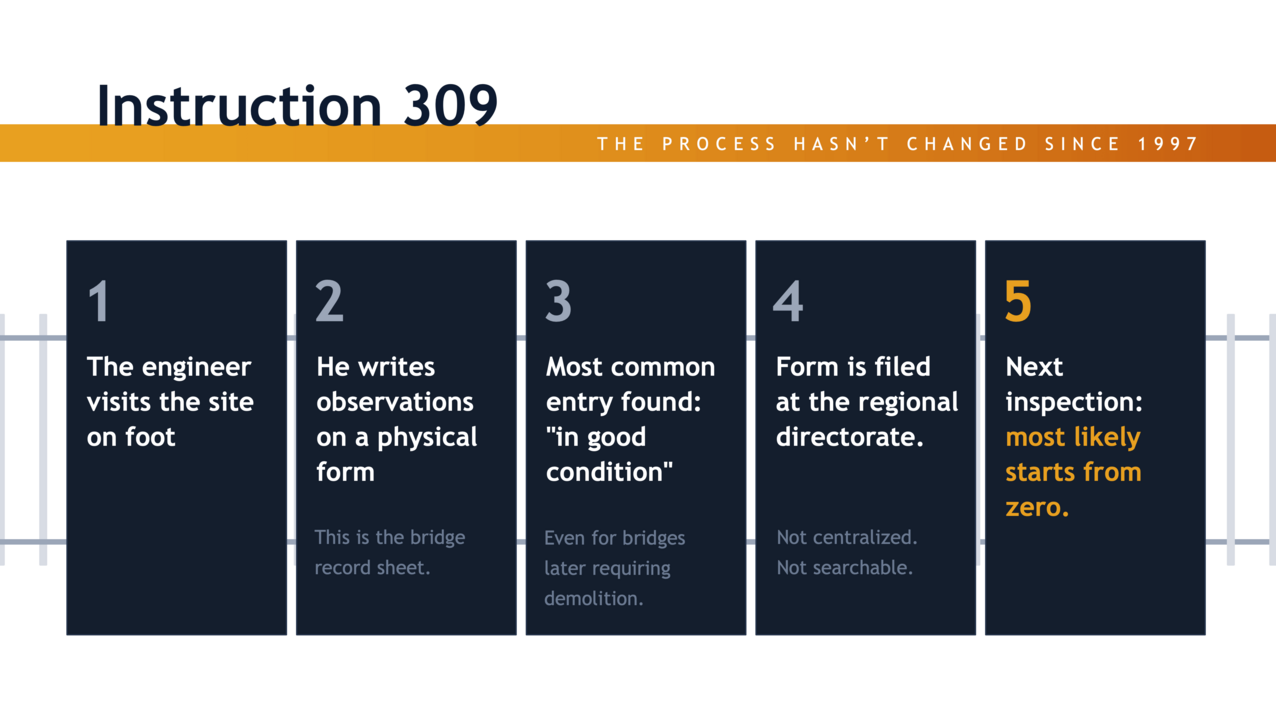
There is a technical instruction in Romania – Instruction 309 – that has governed the inspection and maintenance of railway bridges since 1997. It defines what needs to be checked, how, and how often. It is a rigorous document. However, what it doesn't define is what happens to the information collected.
In practice, inspections tend to be superficial. Water level records, soil condition data, records of interventions over time, documented crack progression – this type of information is largely absent from the bridge record sheets. Yet it's exactly what an engineer needs at the start of a rehabilitation project.
Most commonly, what you find written in the record is: structure in good condition. Sometimes the same structure is subsequently assessed as requiring full demolition and replacement.
What ISPCF and ALLBIM.NET built
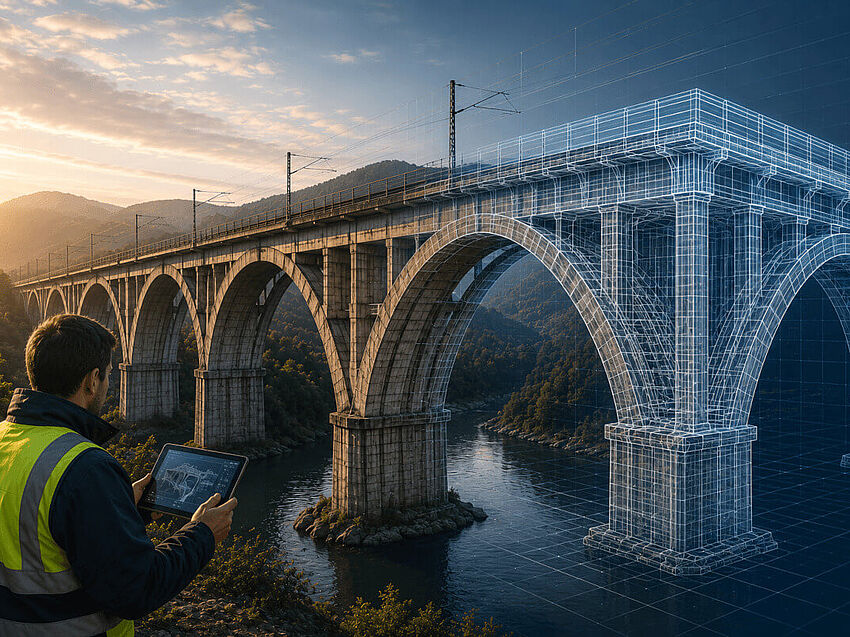
Together, we developed a demonstration scenario in dTwin, simulating how a bridge maintenance district manager could carry out a digital condition survey using the model as the foundation.
The engineer opens the structure on a tablet on site. Using a bridge access staircase as an example, they could attach a photograph, record the defect type, log who identified it and when, when it needs to be addressed, its current status, and track whether it's been resolved. This could all be captured digitally, and all linked to the specific element.
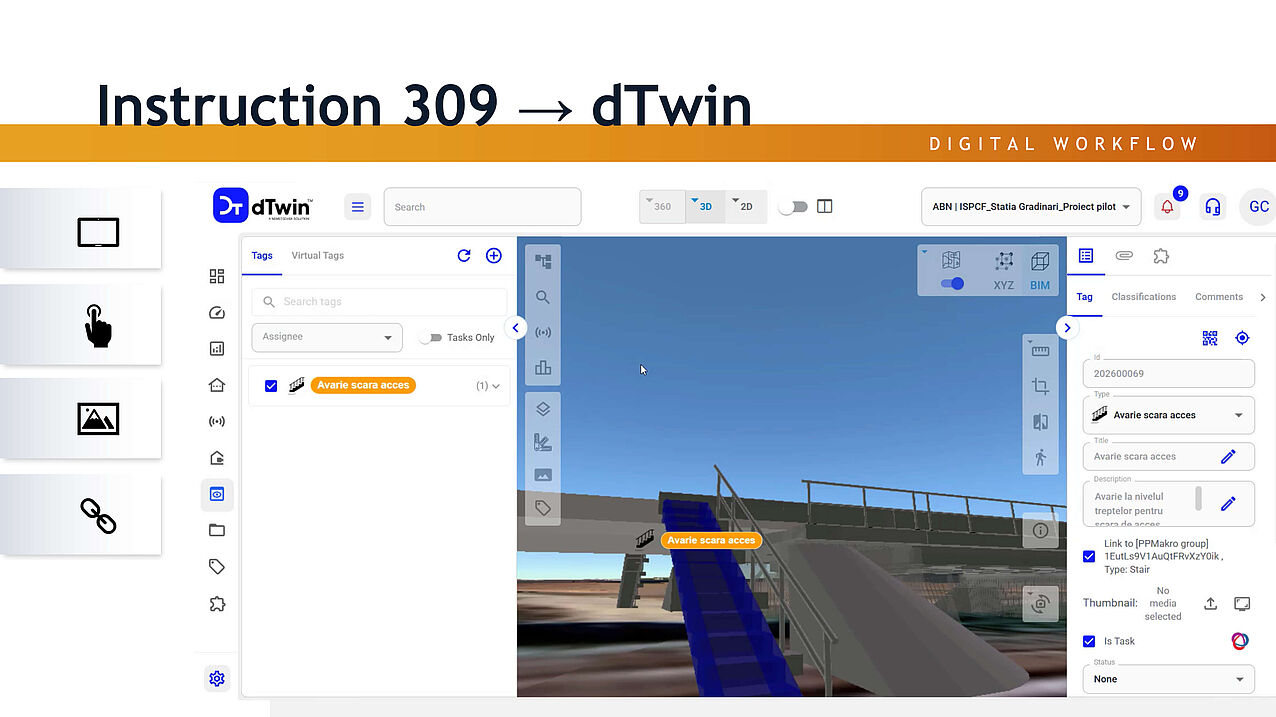
This way, the information doesn't end up in a folder. It stays with the structure.
This method has not yet been deployed in a live project. But it has been proven to work and it was built directly on the framework of Instruction 309, only digitized. The standard isn't the problem. The problem is that without digitizing the operations it describes, the information it's meant to capture simply doesn't survive in any usable form over time.
What this means for infrastructure beyond Romania
Germany mandated BIM for federal infrastructure projects in 2020. France and the UK mandated it for public sector projects in 2016, and Denmark for state clients as early as 2007. For most engineering firms across Western Europe, BIM workflows are standard practice.
What ISPCF's pilot offers is a different kind of case study: not how to use BIM when it's required, but how to build a digital information layer from scratch, in a sector where the data has never been structured, using existing technical standards as the foundation.
Every country has structures that are fifty, seventy, or even a hundred years old and they're all being inspected periodically by engineers with paper forms. This isn't a Romania-specific problem. It's a problem inherent to infrastructure that predates digitalization.
Crucially, the solution demonstrated here doesn't require rebuilding from scratch. It means taking what already works – the existing technical standards – and digitizing the process so that the information remains accessible in fifty years, or even in a hundred years. At the same time, it creates a full, reliable history of the structure.
Six months after the pilot: what changed
ISPCF has demonstrated the capacity to deliver interdisciplinary BIM workflows. The rollout across a growing number of projects has already begun.
But beyond the technical capabilities, something less measurable shifted. The people changed how they think about design. You can't keep working on 2D drawings and calling it a day; improving the model, the workflow, the data, that's the direction that matters. We have a roadmap for this, broken down as follows:
- Short term (1–2 years): A portion of ISPCF's smaller projects will enter BIM workflows. The model will be delivered alongside the drawings, as standard.
- Medium term (3–5 years): Scale. Apply the workflow to larger projects and major railway corridor contracts. Grow the number of people involved until a meaningful proportion of the company can deliver at this level.
- Long term: Make today's problem disappear. When ISPCF takes on a rehabilitation project (a bridge, a structure, or a building) a complete digital technical record is waiting. There will be a full history, accessible in seconds.
One piece of advice
When asked what he would tell a director of a railway infrastructure design firm standing where ISPCF stood before the pilot, Hazaparu's answer was direct: “It's not primarily about software. The real challenge is getting the people in your organisation to move away from 2D workflows and commit to digital models and digital records.”
ISPCF allocated six months to a small project. That meant pulling several dozen people partially away from active design work. There are real costs involved. But at the end of it, they knew exactly what they could deliver and how.
“Invest in people and their development before you invest in technology licences. Without a well-prepared team that actually owns these workflows, the software just sits there,” explains Hazaparu. “It won't be long before the question isn't whether it's worth doing. It'll be how quickly you can close the gap the market will inevitably open between those who have made the transition and those who haven't,” he adds.
Watch the full session
Marius Hazaparu, bridge engineer at ISPCF, presented the full case study at the Global Infrastructure Digital Summit 2026, alongside engineering teams from Turkey, Belgium, Hungary, Switzerland and India.