The Future of Precast is intelligent – and so is the Design Process
Precast producers are entering a market defined as much by where growth is occurring as by how much the overall construction market is growing. According to the National Precast Concrete Association’s 2026 Construction Outlook for the Precast Concrete Industry, total U.S. construction put in place is projected to reach roughly $2.2 trillion in 2026, an increase of just 1%. But beneath that relatively steady headline, growth varies considerably by market segment. Data center spending, for example, is projected to rise 23% to approximately $52 billion, while power, transportation, water and wastewater construction are also expected to grow.
In summary: > Capacity alone isn’t enough. Precast producers also need agility to respond when designs change, schedules tighten or resources become constrained. > Connected precast detailing software can help keep models, drawings, reinforcement and production information coordinated, reducing manual rework when changes occur. > Automation and AI can improve agility when they’re applied to specific, measurable workflow challenges and used to extend the expertise of experienced teams. > Building a more agile precast operation starts with identifying where information gets stuck, manual work accumulates and changes create unnecessary disruption. |
Those opportunities come with another reality. NCPA notes that labor availability, permitting timelines and equipment lead times are increasingly influencing who can win and successfully deliver the work. For precast producers, that means opportunity and constraint can exist at the same time. Capitalizing on that opportunity requires an operation that can respond effectively when schedules tighten, requirements change or resources become constrained.
As producers evaluate precast detailing software, automation and other digital tools to improve that responsiveness, the focus is shifting from making individual tasks faster to helping the entire operation adapt when something changes. That ability to adapt is what separates capacity from agility.
Capacity and Agility Are Not the Same Thing
When demand increases, the natural response is often to think about capacity: more people, more production space, more equipment or more shifts. Those investments may be necessary, but capacity alone does not make an operation more responsive.
A precast plant can have room in its production schedule and still be waiting for approved detailing information. An engineering or detailing team can add resources and still lose time recreating information, manually updating drawings or checking whether a revision has reached every affected deliverable. Because detailing sits directly upstream of production, delays can quickly reach the plant and the project schedule.
The Real Test of Agility Is What Happens When Something Changes
Consider a design change that arrives shortly before a scheduled pour. A wall moves, an opening changes, reinforcement needs to be adjusted or a field condition requires a different detail. The change itself may be straightforward, but its consequences may not be.
Sections, reinforcement, embeds, bar lists, drawings and other production information may all be affected. If those outputs are maintained separately, someone has to identify every dependency, make the necessary updates and confirm that everyone downstream is working from current information. Under an already compressed schedule, even relatively small changes can create a cascade of manual work.
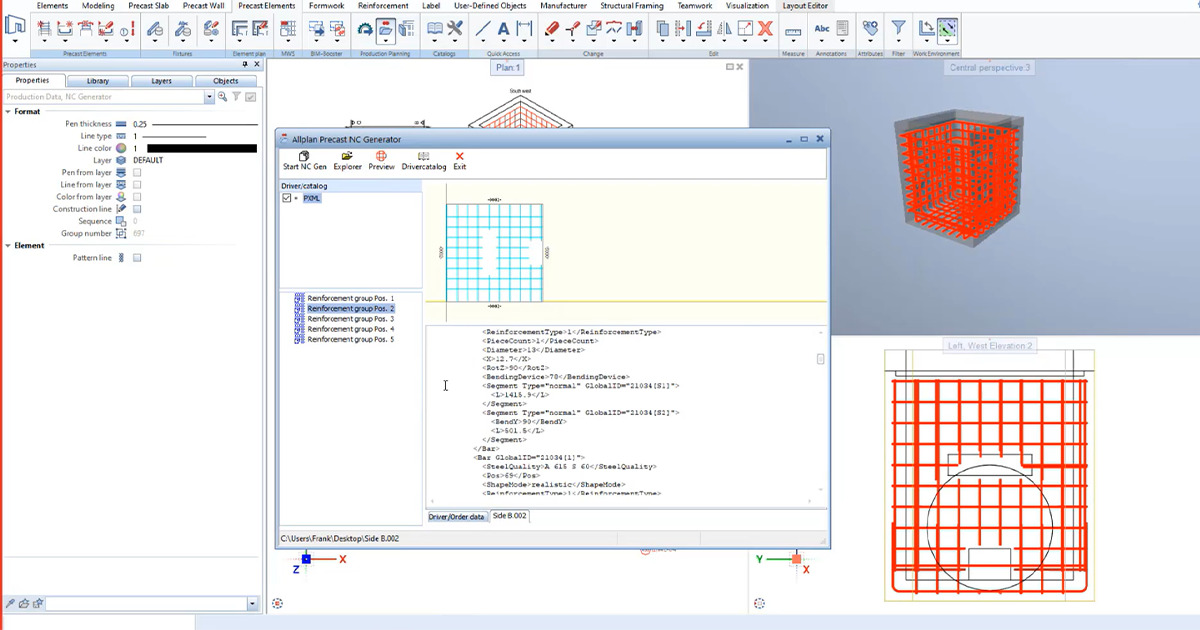
With the right precast detailing software and connected processes, information developed during modeling and detailing can remain coordinated with the outputs that depend on it. When something changes, teams can spend less effort reconstructing what happened across separate drawings, files and datasets and more effort reviewing and responding to the change itself.
Connected Information Makes Change Easier to Manage
Digitizing individual tasks does not necessarily create an agile workflow. Information still has to move between engineering, detailing, production and other teams responsible for getting an element from design through fabrication and ultimately to the jobsite.
Different specialists need different tools and levels of information. In a connected workflow, reliable information remains usable, traceable and current as it moves between them.
That continuity should also work in both directions. Engineering decisions inform detailing, and detailing informs production. But production teams also develop valuable knowledge about constructability, recurring issues and what works most effectively in the plant. Bringing that experience upstream gives teams an opportunity to address problems earlier rather than repeatedly solving them downstream.
Automation Should Follow the Problem, Not Lead It
AI and automation add another dimension to the agility conversation, with new technologies offering opportunities to accelerate specific tasks and processes. The greatest value starts with understanding where improvement is actually needed.
Whether evaluating detailing technology, model-based automation or emerging AI capabilities, a better starting point is the problem. Where is the organization consistently losing time? Which repetitive activities consume skilled resources? Where do revisions create the most rework or leave production waiting for information? Once the problem and its impact are understood, teams can determine whether technology can meaningfully improve it.
Producers can start with a narrow, repeatable challenge, establish a baseline, introduce improvements and measure the result. Successful improvements can then expand from there, keeping technology grounded in the realities and priorities of the operation.

Agility Depends on Expertise, Not Just Technology
Precast is an expertise-driven industry. Experienced detailers, engineers and production professionals accumulate knowledge that is difficult to capture in a procedure manual. They understand what can realistically be fabricated, transported and erected, recognize details likely to create problems before they reach the shop, and know the practical decisions that keep work moving.
Automation can extend the value of that expertise. Reducing repetitive drawing updates, data entry or routine detailing work can give experienced professionals more time to review constructability, solve exceptions and make decisions that require judgment. Better-connected information can also make knowledge easier to share instead of leaving critical practices dependent on a few individuals.
Technology can support consistency and speed. People provide the context and judgment to know when the standard approach works and when a situation demands something different.
Build the Ability to Adapt
No precast producer can know exactly what the market will look like five years from now. Demand will shift, customer expectations will evolve, AI and automation will advance, and workforce challenges will change. Operational agility gives producers a stronger foundation for navigating that uncertainty by understanding where friction exists, making deliberate improvements and maintaining control of the information that connects design, detailing and production.
How Agile is Your Precast Workflow?
Identifying where information slows down, manual work accumulates or changes create unnecessary disruption is an important first step toward building a more adaptable operation.