
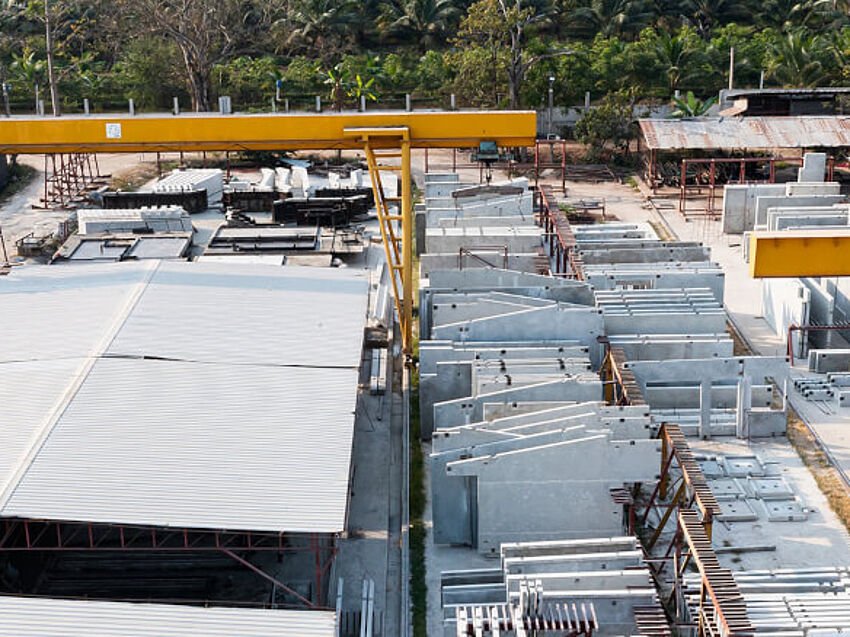
Why Agility Is Becoming the New Competitive Standard in Precast
Author: Patrick Spink, U.S. Sales Manager, Manufacton
Prefabrication has become one of the most important strategies for contractors looking to improve productivity, address labor shortages, and meet increasingly compressed project schedules. What was once considered a competitive advantage is quickly becoming a business necessity.
In summary: > Prefabrication is becoming essential for improving productivity, addressing labor shortages and meeting tighter project schedules. > As prefab operations grow, disconnected tools and processes can make it harder to manage production, materials, capacity and delivery. > Real-time production visibility helps teams identify bottlenecks, reduce rework and make more informed decisions. > Prefabrication management software connects key workflows, giving contractors the visibility and control needed to scale efficiently. |
Nowhere is this more evident than in high-growth sectors such as data centers, pharmaceuticals, and advanced manufacturing. Recent industry research suggests prefabrication can reduce data center project timelines by 30% to 50% while helping organizations address skilled labor constraints.
Yet as contractors expand their prefabrication operations, many discover that fabrication capacity alone is not enough. The processes that work for a handful of prefab orders often struggle to scale as production volumes increase, creating new challenges around planning, scheduling, material management, and delivery coordination.
The reason is often not fabrication itself. It's visibility.
Industry leaders increasingly recognize that the future of construction looks more like manufacturing. As organizations adopt prefabrication, digital production management, and factory-based construction methods, they are applying lessons learned from industries such as automotive and aerospace, where visibility, production control, and process optimization have been standard practice for decades.

At recent industry events such as NXT BLD, experts highlighted how industrialized construction and manufacturing-driven workflows are reshaping project delivery. For contractors looking to scale prefabrication successfully, these trends point to an important reality: visibility and production management are becoming just as important as fabrication capacity itself.
The Shift from Construction to Manufacturing
For decades, contractors managed projects primarily from the jobsite. Materials arrived as needed, work was coordinated in the field, and project managers focused on a relatively small number of active projects at a time. Prefabrication changes that model entirely.
When fabrication moves offsite and into a dedicated facility, contractors are no longer simply managing construction projects. They are managing a manufacturing operation. This shift introduces new challenges that many organizations are not prepared for.
A project manager who is comfortable overseeing a single project may suddenly find themselves responsible for coordinating production across dozens of active jobs, managing material availability, scheduling resources, and balancing competing priorities within a fabrication facility. The processes that worked on the jobsite often struggle to scale in a production environment.

Why Productivity Stalls
Many prefabrication operations begin with familiar tools such as spreadsheets, email chains, whiteboards, sticky notes, and shared drives. While these approaches may work when managing a handful of orders, complexity grows rapidly as production volumes increase.
Without centralized visibility, teams often struggle to answer basic operational questions:
> What is currently in production?
> Which orders are at risk of being delayed?
> Do we have the materials required to complete scheduled work?
> What is the current capacity of the shop?
> Which projects should take priority?
> Where are production bottlenecks occurring?
When those questions cannot be answered quickly and confidently, productivity suffers. Instead of proactive decision-making, teams spend valuable time searching for information, tracking down updates, and reacting to problems after they occur.
The Hidden Cost of Disconnected Workflows
The consequences extend far beyond inefficiency. When fabrication teams rely on disconnected systems, critical information can easily be missed. Design changes may be communicated through email, production updates may live in spreadsheets, and delivery schedules may be tracked elsewhere. The result is often rework.
An assembly may be fabricated using outdated information, shipped to the jobsite, and discovered to be incorrect upon arrival. The contractor must then either modify the component in the field or send it back for rework. Both options are costly.
Disconnected workflows also create uncertainty across the organization. Field teams cannot confidently plan installations. Project managers struggle to communicate accurate delivery schedules. General contractors are left waiting for updates. Customers lose confidence. In many cases, the issue is not that teams lack information. The information exists. It's simply scattered across multiple systems and individuals.
Why Production Visibility Matters
Production visibility means having access to real-time information about every stage of the prefabrication process. A production manager should be able to understand shop capacity, labor availability, material status, production progress, delivery schedules, and project priorities at any given moment.

This visibility remains a challenge for many organizations. According to recent industry research, fewer than 30% of contractors track productivity across VDC, shop throughput, and material logistics in a connected way. As fabrication becomes increasingly central to project delivery, disconnected workflows can create blind spots that affect planning reliability, schedule performance, and operational efficiency.
When that visibility exists, organizations can move beyond reacting to problems and begin proactively managing production. Risks become easier to identify before they affect project schedules. Capacity planning becomes more accurate. Decisions are driven by operational data rather than assumptions. Visibility becomes the foundation for better construction production management.
Scaling Prefabrication Requires More Than Additional Capacity
Many contractors assume that growth requires larger facilities, more labor, or additional equipment. In reality, many organizations first need better operational control. Without visibility into production workflows, adding capacity can simply increase complexity.
Successful prefabrication programs focus on creating repeatable, measurable processes that support growth. They understand how work flows through the shop, where bottlenecks occur, and how resources are being utilized.

The impact of production visibility is already being demonstrated by contractors adopting modern prefabrication workflows. After implementing Manufacton, electrical contractor Pieper Power increased its prefab order volume from approximately one to two orders per week to 10 to 20 orders per week while gaining greater visibility into production status, delivery schedules, and labor planning.
This level of insight enables contractors to scale with confidence while improving construction production management, schedule performance, and quality standards.
How Prefabrication Management Software Supports Growth
As prefabrication operations mature, many contractors recognize that spreadsheets and disconnected point solutions can no longer support the demands of production. This is where prefabrication management software becomes critical.
A centralized platform such as Manufacton by Allplan connects design, procurement, fabrication, quality control, delivery, and field coordination within a single workflow. Rather than managing information across multiple systems, teams gain a single source of truth for production activities.
This enables:
> Greater visibility into production status.
> Improved capacity planning.
> Better coordination between office, shop, and field teams.
> Reduced rework caused by outdated information.
> More accurate delivery schedules.
> Improved schedule predictability.
> Better decision-making based on operational data.
Perhaps most importantly, it gives contractors confidence in their ability to scale prefabrication programs successfully.
The Future of Prefabrication Is Visibility
The industry has moved beyond the question of whether prefabrication works. Today, the challenge is how to scale prefabrication efficiently.
Contractors that continue to rely on disconnected workflows may find it increasingly difficult to keep pace with growing project demands and compressed schedules. Those that embrace production visibility, data-driven decision-making, and integrated workflows will be better positioned to increase throughput, improve predictability, and deliver projects more efficiently.
The future of prefabrication isn't simply building more in the shop. It's building smarter through better visibility and production management.
See Prefabrication Visibility in Action
Want to see how contractors are using digital production management to reduce labor waste, improve material tracking, and eliminate costly rework?
Watch our on-demand webinar featuring Collins Electrical and discover how Manufacton helped the company transform its prefabrication operations and gain greater visibility.
Ready to improve visibility across your prefabrication operations?

About the Author
Patrick Spink is the U.S. Sales Manager for Manufacton by Allplan and a recognized advocate for modernizing prefabrication operations. He works closely with contractors across North America to help them transition from manual, disconnected workflows to data-driven production management processes that improve visibility, efficiency, and scalability.